Creative Commons Attribution-Share Alike 4.0
A night of terror has left the Ukrainian capital reeling. Russian forces launched one of their most coordinated and violent barrages in weeks, killing at least 13 people and injuring over 30 others. Local officials have confirmed that children are among the casualties, while search and rescue teams continue to desperately dig through the rubble.
What Happened Overnight?
Powerful explosions rocked Kyiv at around 3:30 AM local time, forcing the immediate evacuation of several neighborhoods. According to the Ukrainian Air Force, Russia deployed a massive swarm of 74 missiles and 496 kamikaze drones.
While Ukraine’s air defense systems successfully intercepted the majority of the incoming threats, 25 ballistic missiles and 12 drones managed to slip through, striking 33 different locations across the city.
Destruction on the Ground
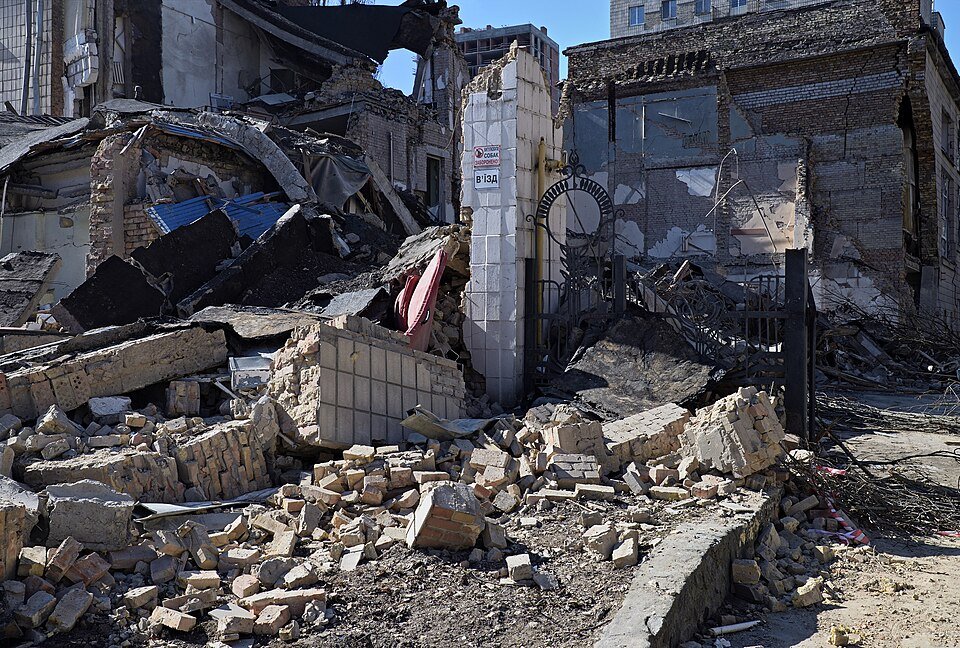
As daylight broke over Kyiv, the true scale of the devastation became clear:
- A major hotel on a central boulevard was completely engulfed in flames.
- An ambulance station sustained heavy damage, leaving at least one medical worker in critical condition.
- The streets were littered with charred cars, massive craters, and thick smoke rising from high-rise residential buildings.
So far, emergency responders have managed to pull 34 survivors from the wreckage of a collapsed apartment complex in the southeastern part of the city.
Political Fallout and Zelensky’s Warning
The scale of this attack did not come as a complete surprise. President Volodymyr Zelensky cut short an official visit to Dublin just a day prior, citing fresh intelligence that Moscow was plotting a “massive” strike.
In the wake of the bombardment, Ukrainian Foreign Minister Andriy Sybiha issued a blunt demand to international allies on X (formerly Twitter):
Moscow’s Stance and the Frontline Reality
Russia’s Ministry of Defense acknowledged the strikes but claimed they strictly targeted energy infrastructure. Moscow framed the operation as retaliation for recent Ukrainian drone strikes on Russian power stations—attacks that Russian President Vladimir Putin recently admitted have caused domestic fuel shortages.
On the ground, the war remains largely deadlocked in entrenched positions, though Russian forces have recently edged into the strategic eastern town of Kostyantynivka. Currently, Russia occupies roughly one-fifth of Ukraine’s territory since the full-scale invasion began in February 2022.